Allergies and Health

Allergy information, treatment and prevention

  • Food Allergies
  • Skin Allergies
  • Allergy Management
  • Asthma
  • Eczema
  • Dust Allergy
  • Testing
  • logo
You are here: Home » Eczema » Where on the Body does Eczema Occur

Where on the Body does Eczema Occur

Eczema is a range of skin conditions often referred to as dermatitis. It is relatively common afflicting around 20 percent of the population at some point in their life and manifests itself as a dry, itchy rash.

There are several types of Eczema; some have recognizable causes such as contact with an irritant chemical, however, the most common form is atopic dermatitis which generally affects people of an allergic disposition. Atopic eczema is often seen in those who also suffer from hay fever or asthma and there is thought to be a genetic component in who is likely to get it.

The atopic eczema rash itself can vary quite a lot from one individual to another. Whilst it is always red and itchy the skin may also be flakey, blistered or even weepy.

Whereas contact based allergies and sensitivities will usually affect only the part of the body they come into contact with atopic eczema rashes seems to be quite predictable in their location. What is more, the parts of the body affected by eczema appear to vary with age.

Parts of the Body Affected by Eczema

Whilst eczema flare-ups can affect the whole body this is unusual. Sometimes referred to as the wandering rash, eczema tends to follow a general pattern with where the rash appears depending on the age of the person. It has been suggested that during the early years the pattern of the rash is influenced by where the child is able to scratch themselves.

Infants and toddlers
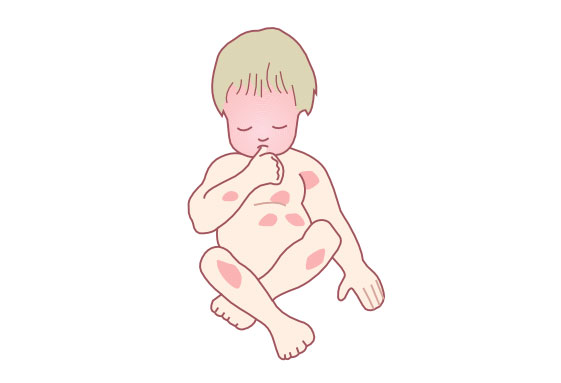
Location of eczema - infant

  • With babies the first signs of eczema are usually on the face, particularly the cheeks.
  • There may be a patchy rash affecting anywhere on the body with the legs, backs of the arms and the back the most common areas.
  • As the child becomes more mobile the rash sometimes settles on the lower legs.
  • After the first year the eczema is often located on the outside of the joints; wrists, elbows, ankles and knees.  It can also affect the genitals.

Pre-schoolers

Pre-schooler eczema location

  • The most common area of the body affected in this age group are the inner surfaces (creases) of the elbows and knees. These are known as the “flexuaral” areas and this is sometimes referred to as flexure eczema.
  • External surfaces of joints may still be affected, i.e. wrists and ankles.
  • Feet are more likely to have the rash than hands in young children

Adults

Adult eczema rash distribution

  • Throughout the school years eczema flare-ups tend to be localized to the creases of the elbows and knees.
  • For the majority of eczema sufferers the symptoms clear up by the teens.
  • If eczema does not clear up by adulthood the pattern and symptoms may change.
  • Along with the flexuaral areas adults tend to have eczema on the hands, scalp, eyelids and nipples. These areas are often those exposed to irritants or allergens as there is an increased likelihood of sensitive skin in eczema sufferers.

Atopic dermatitis is often considered a childhood condition as the typical onset is before the age of two (although it can be as an adult). The symptoms tend to be at their worst between the ages of two and four after which they improve, hopefully clearing up by the teenage years.

(Visited 3,485 times, 1 visits today)

All Topics

  • Allergic Rhinitis
  • Allergy Management
  • Allergy Treatment & Medications
  • Anaphylaxis
  • Asthma
  • Cat & Dog Allergies
  • Chemical Sensitivity
  • Childhood Allergies
  • Diagnosis & Testing
  • Drug Allergies
  • Dust Allergies
  • Eczema
  • Eye Allergies
  • Food Allergies
  • Food Intolerance
  • General
  • Latex Allergies
  • Mold Allergies
  • Seasonal Allergies
  • Skin Allergies
  • Symptoms
  • Wasp & Bee Sting Allergy
Leaky Gut Syndrome – Facts & Myths
10 years ago by allergist 7 min read No comments
Leaky Gut Syndrome

Over recent years a lot of attention has been given…

Can you have an allergy to swimming pool water?
10 years ago by allergist 5 min read No comments
Swimming pool chlorine allergy

Quite a few years ago I started swimming more seriously.…

Why are Allergies Increasing
10 years ago by allergist 4 min read No comments
Allergy increase

There is little doubt that during the last 50 years…

Sticking Plaster Allergy
10 years ago by allergist 4 min read No comments
Plaster adhesive allergy

The other day I fell off my bike and scraped…

10 Tips to Get Rid of House Dust Mites
10 years ago by allergist 6 min read No comments
Dust mite

What are dust mites? House dust mites are a tiny…

Latest Articles

  • UK Pollen Calendar
  • Autumn Allergies
  • Leaky Gut Syndrome – Facts & Myths
  • Can you have an allergy to swimming pool water?
  • Is Yoghurt Good for Allergies?

Popular Articles

  • Sticking Plaster AllergyPlaster adhesive allergy The other day I fell off my bike and scraped my leg up pretty badly. Having a graze this big…
  • UK Pollen Calendarcalendar-pollen Generally speaking there are three main groups of culprits that release their pollen during different parts of the spring and…
  • Allergies and HealthAllergies and Health Welcome to Allergies and Health, a comprehensive guide to all issues relating to allergies.
  • Are Mouth Ulcers Caused by Allergies?Mouth ulcer Those of us of who have suffered from regular mouth ulcers will probably be familiar with the feeling of frustration…
  • Can you have an allergy to swimming pool water?Swimming pool chlorine allergy Quite a few years ago I started swimming more seriously. I would go to the swimming pool two or three…

Disclaimer

The information provided on this website is well researched and we believe it to be accurate at the time of writing. However, it should be regarded as for educational purposes only and not as medical fact. If you do have any medical concerns or symptoms we do not recommend you use this website as a substitute for visiting an allergist, licensed physician or doctor.

Copyright © 2026 Allergies & Health